Saturday, November 30, 2013

Activity 3: Wire Resistivity


Aim: To find the relationship between the length, area and density of wire with resistance.
Hypothesis:
  1. As length of wire increase, the resistance increases
  2. As wire area increases, the resistance increases
  3. As wire density increases, the resistance decrease
Theory background:
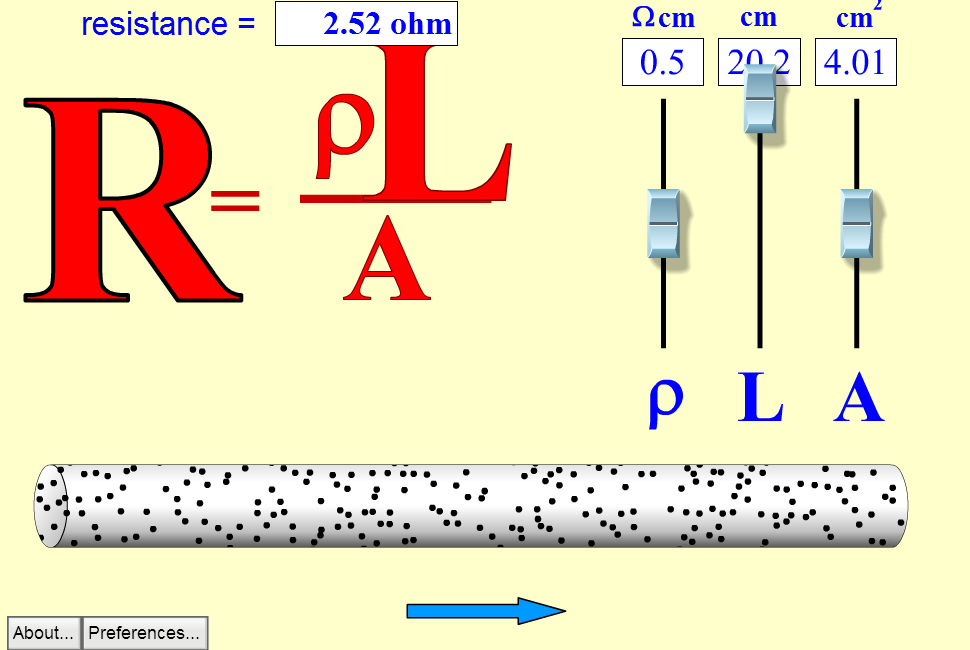
Resistance is a measure of how material resist the flow of an electrical current. It is measured in Ohm (Ω). Ohm’s law states that V=I x R. The resistance of a wire can be greater for a longer wire, less for a wire of larger area and depends on the material that is use to make the wire. The resistance of a wire can be  expressed as


Manipulative Variables:
Independent:Length of wire, area of wire, density of wire
Dependent: Relationship between the length of wire, area of wire, density of wire and resistance
Controlled: Formula
Materials:
  • Formula
  • Wire
Method:
  1. Open te website
  2. Download the application
  3. *applications shows out* Try to increase or decrease the length, wire and density of wire and look at the resistance.
  4. Conclude the experiment
Data Collection:

DENSITY


LENGTH


AREA


Analysis:
So from several datas above we can see that the first one shows that if the density increase the resistance will be increasing as well. Then from the second data, it shows that if the resistance still increase it doesnt metter with the resistance both of them is increase. It is difference from the the first and second, the third one shows that if the area is big the resistance will be smaller.

Conclusion:
So the hypothesis is wrong because like what we can see, resistance decrease when the area is increase and the resistance increase when the density increase.

Resources: file:///C:/Users/Dell/AppData/Local/Temp/phet-resistance-in-a-wire/resistance-in-a-wire_en.html

-Shannisya, Naomi, Andra, Ibram
10 Centaurus

Thursday, November 28, 2013

Activity 2: Electrical Components and Function


Name
Info
Picture
Wire: Conduct current
They move electricity from one component to another


Battery: Move electrons
They are the power source. The chemical reaction inside of them separates positive charges from negative charges and puts each one at one end of the battery or cell.

Connector:Interfacing internal circuits
Connectors are a way to temporarily connect a device to another

Switch; Mechanically Control the Flow of Current
It uses to make or break connections

Resistor :Limit current
Resistors restrict the flow of electricity in a device.

Capacitor: storage charge
So, the capacitor is the storage of a device.


Relay; Electricity switch
Relays are electric switches.  Some times the amount of electricity flowing in a device is so high that it is dangerous to humans.


Diode; Block current
Diodes let current flow only one way in a device.  They are important to block electricity that could flow the wrong direction. 

Transistor; Electricity switch
transistors act as electronic switches.  However, in the case of transistors, they operate faster and with even less electricity.


Activity 4: Ohm's Law

Aim: To find the relationship between voltage, current and resistance.

Hypothesis: As voltage increases, current increases. As resistance increases, current decreases.

Theory Background:
Voltage is an electrical potential difference. It is the potential energy that makes the electrical current flow in a circuit by pushing the electrons around. The unit of voltage is volt (V). Electric current is the rate which a charge flows through a surface. It is measured in Ampere (A). Resistance is a measure of how material resist the flow of an electrical current. It is measured in Ohm (Ω). Ohm’s law states that V=I x R. It shows that V is directly proportional to I and R. So, as the voltage increase, the current and resistance will also increase. This formula also shows that current and resistance are inversely proportional- as current increases, the resistance will decrease.

Manipulative Variables:
Independent: Current, Resistance, Voltage
Controlled: Formula (V=IR)
Dependent: Relationship between voltage, current and resistance.

Materials:
  • Formula

Method:
  • Move the potential and resistance sliders and observe the current
  • Fill in the tables and check with the formula

Data Collection:
Procedure Part 1:
As the resistance increases, current decreases
As voltage increases, current increases


Procedure Part 2:


V = I        x R
Voltage (V)
Current (I)
Resistance (R)
8.0 V
0.01 A
800 Ω
2.0 V
0.044 A
45.45 Ω
2.49 V
0.0058 A
430 Ω
6.9 V
0.069 A
100 Ω
6.4 V
0.021 A
300 Ω


Conclusion:
  1. Incandescent light bulbs have a very thin filament that glows when hot. Thin filaments have very high resistance.
  2. The 12 V battery in our car operates a 25 amp car stereo. The resistance of the stereo is 0.48 Ω
  3. A “2D” Maglite flashlight runs 3.0 V. The current through the bulb is 5 A when the resistance is 15 Ω
  4. An iPod charger must provide 29.75 V to charge an iPod using 0.85 amps at 35Ω
  5. It is not a really good idea, because when we rationalize that four such 50 ft cords will do the job, the resistance will four times higher and the voltage drop will be four times higher as well. Due to the voltage drop, it is not enough to power a stereo.

Resources:


-Shannisya, Naomi, Andra, Ibram
10 Centaurus

Activity 1: How is Electricity Generated and Transmitted?

How is electricity generated?
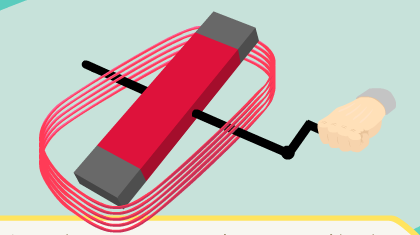
  1. By spinning a magnet within a coil of wire

Electricity will be made in the wire.

  1. The solar energy or the energy of sunlight can be used to generate electricity by using special type of solar panels named photovoltaic cells. These solar panels contain silicon which produce electricity when sunlight falls on them.


  1. In a coal, oil or gas power station, they burn fuel to make water turn to steam. The steam is used to turn a steam turbine (in a form of big wheels). This will turn the generator.


  1. In hydro-electric power station, water is dropped through a big wheel which makes it turn. This is connected to the generator.


  1. In Nuclear power stations, they use uranium as their radioactive fuel. The heat produced by the reaction between uranium atoms and neutrons (split into two and create heat, radioation and more neutron) is then used to make the steam that runs the turbine which generate the electricity.

  1. In biomass powerstation, the fuel are from trees, shrubs, animal poo, which are burned in a boiler in order to produce a high-pressure steam. The steam will rotate the turbines which then turn the generator that will produce electricity.
7. Geothermal energy uses the steam from hot water reservoir beneath the earth. The engineers will need to drill the reservoir and as the water rises to the surface, it will begin to boil and the steam will be used to turn the turbines which turn the generator and will produce electricity.


How electricity are transmitted?
  • Electricity are produced in power plants by huge generators (fuel: coal, natural gas, water,wind)


  • Current is sent to the transformers. The transformers will push the power.


  • The electrical charge will go through the transmission lines


  • It will go to the substation. Here, the voltage will be lowered so that it can be sent to smaller power lines


  • Then, it will travel throught the distribution lines in the neighbourhood. The transformers in each pole top lowered the voltage again so that it can be distributed to each houses.


  • When it reaches to our house, it will pass through a meter which indicates how much the our family used electricity


  • The electricity will go to the service panel and travel through all the wires in our house.


Sources:
-Shannisya, Naomi, Andra, Ibram
10 Centaurus